
The Correction Landed Before the Sell-Side Did
Friday’s piece, Sold Out Through 2028: Hurlston’s Tokyo Interview and the Optical Cold War, had a Credo section I updated earlier tonight after reader pushback. The original framing I published Friday afternoon, before the correction, was this: “Their optical DSP showed impressive engineering at OFC, but a great product in a contracting market is a challenging investment thesis.” That line was wrong on both halves. A technically sharp paid subscriber sent a detailed pushback Sunday morning. He walked me through the NVIDIA platform roadmap, pointed at Cignal AI data showing no material CPO impact on pluggable transceiver shipments through the next three years, and argued that the entire bear case rested on a timeline assumption that does not match NVIDIA’s own disclosed plan of record. He was right. The Friday piece is now updated online with the corrected view, crediting the reader’s pushback and citing the NVIDIA roadmap directly. This piece is the deeper follow-up I promised at the bottom of that correction, and it is shipping the same night as the correction itself because the sell-side did not wait either.
At 4pm Pacific today, hours before this piece went live, Jefferies’ Blayne Curtis initiated coverage of Credo with a BUY rating and a $175 price target on a thesis that converges directionally with the corrected view. When a reader correction, a major sell-side initiation, and a primary source I had been sitting on for weeks all converge on the same conclusion inside a single Sunday, the piece that writes itself is the one you are reading now. The primary source is the part that changes the weight of everything else, so let me put it on the table before the rest of the framework.
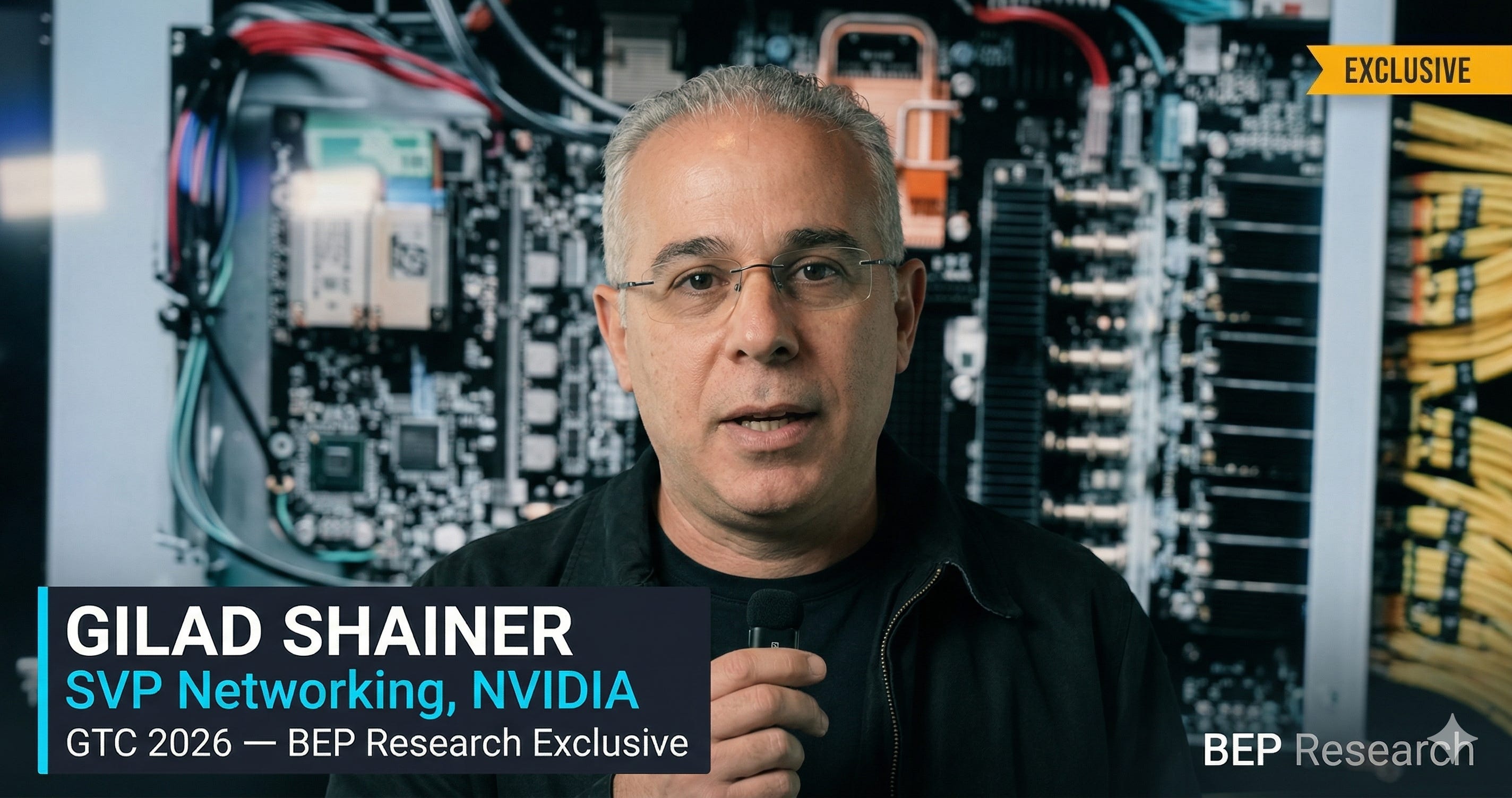
At GTC in March, NVIDIA’s SVP of Networking, Gilad Shainer, sat down with me in front of the Spectrum-X co-packaged optics demo at NVIDIA’s own booth and told me, on camera, how NVIDIA thinks about copper versus optics in the AI datacenter. His framing was as direct as a senior NVIDIA executive is allowed to be. “Everywhere you can use copper, you use copper. And the reason is that copper consumes zero power. If you can use copper, we use. Period.” He then explained why: “Power is the key element that determines my compute capacity in a given data center. I want to minimize power forever. I can.” And he put a specific timeline on when scale-up finally goes optical: “More of a 2028 story,” tied specifically to the Feynman generation when scale-up domains expand to 1,152 GPUs and the distances physically break copper. In tonight’s correction to the Friday piece, I cited Gilad’s public comments to SDX Central expressing the same view, because at that point my own footage was still unreleased. The video below is the BEP Research primary source behind that attribution, and it says the same thing Gilad has said publicly, on camera and unprompted, inside a thirty-minute conversation at NVIDIA’s booth. The consistency is the point: this is Gilad’s settled position, not a soundbite. I held the footage until now because the framework I needed to anchor it did not exist yet. The reader’s correction clarified the framework. The video goes live with it.
The Bear Case Was Asking the Wrong Question
For six months, the conversation about Credo has started with the same question. When does co-packaged optics kill copper. How fast does the AEC market shrink. Is Credo trapped in a contracting niche while the optical transition runs the company over. The bear case rests on a single architectural assumption: that CPO is imminent, copper is on borrowed time, and anything dependent on inside-the-rack copper has a terminal value problem. Both halves of that assumption are wrong, and the first half is wrong on a timeline anyone can reconstruct from NVIDIA’s own disclosed roadmap.
Vera Rubin NVL72 in H2 2026 is all-copper intra-rack scale-up. Kyber Ultra NVL144 in H2 2027 stays copper-to-switch. NVL576 connects eight Oberon racks via CPO for inter-rack links but keeps copper inside each rack. The first platform where CPO might replace copper inside the rack is Feynman NVL1152 in late 2028, and SemiAnalysis’s base case there is still copper-to-switch as plan of record because of manufacturing cost and reliability. Gilad’s “2028 story” framing on camera is the same answer as the one I wrote in Friday’s corrected section, which is the same answer the reader arrived at independently from public NVIDIA disclosures and Cignal AI data. When three vectors that started in different places all land on the same conclusion, the pattern is the signal. And it reinforces what Bill Brennan said on the February earnings call, which I covered in Credo’s Q3 Call Answered Every Question after the $407 million print: the industry remains “early in its AEC adoption.” After a record quarter, Brennan was telling us the runway had barely started. Friday’s framing forgot that. The corrected view puts it back in the model.
The deeper argument underneath the timeline is the one that actually matters, and Gilad put it directly. Power per compute is the binding constraint of the gigawatt-scale buildout. Copper consumes zero power. Optical transceivers consume measurable power at every hop. If you can cover a distance with copper, you cover it with copper, because every watt saved on interconnect is a watt spent on the GPU. CPO happens when distance physically forces it, not one moment sooner. That is the architectural worldview inside NVIDIA networking, and it is why the “use copper, period” framing is as forceful as it is. It also means the market has been modeling the wrong variable. The question is not when CPO kills copper. The question is how long NVIDIA’s power-optimization logic keeps copper inside the rack while optical volumes scale on the outside of the rack, because both can be true at the same time, and on the actual roadmap both are.
And while the market has been arguing about copper’s terminal value, Credo has been building a product that moves the company from defending one TAM into attacking a much larger one. Almost nobody in the consensus Credo model is paying attention to it.
Below the paywall: the full Gilad video, what ZeroFlap actually is and why it changes the Credo business model, the two-TAM framework that resolves the copper-versus-optics debate, what Gilad also said on camera about Lumentum and Coherent as NVIDIA’s named ecosystem partners, the bear case I am still carrying, and how the corrected view changes the Credo position inside the Optical Cold War framework.
Leave a Reply