
The wires will lead with the numbers. Q1 product revenue up 208 percent year over year. Non-GAAP EPS at $0.44 against a $0.13 consensus, a 3.4x beat. GAAP net income flipped from a $23.8 million loss to $70.7 million. Adjusted EBITDA roughly 6x.
Then they will lead with the guide raise. Management moved every line: revenue, margin, operating income, EPS.
What the wires will not lead with, and what the sell-side notes Tuesday morning will likely undercount, is what K.R. disclosed in Q&A. Three operational data points that should reset the bull case, plus a TAM-expansion comment that nobody on the call seemed to fully register. The print is the catalyst. The Q&A is the thesis.
The Guide Caught Up
Two weeks ago, in “Oracle Just Signed the MSA Bloom Was Waiting For,” I closed with a watch list for tonight’s call. The first item: “does management raise full-year guidance, or hold and let the upside accumulate into the back half?”
Management raised. Not at the margin. Every line moved. From the call:
“The strength of the quarter and the commercial momentum we see across the board gives us conviction and confidence to raise guidance materially… You can see we are prioritizing growth and profitability in equal measure.“
Read that last line carefully. The standard sell-side bear pushback for a guide raise of this magnitude is “they bought it with margin.” K.R. and Simon pre-empted that on tape.

In February I modeled $1.40 in non-GAAP EPS for 2026 and roughly $3 to $4 in 2027. Tonight management put up a 2026 EPS range that lands above my prior number by 30 to 60 percent. They did not let upside accumulate into the back half. They pulled it forward.
This is not a beat-and-raise quarter in the ordinary sense. It is the quarter where the P&L caught up to a backlog the market had already been told about. The contracts were signed. The customers were named. The 800V DC alignment was published in writing by an Oracle EVP on April 13. What was missing was the management number that converted those facts into a forward earnings line analysts could put in a model.
Twenty-Five Years to Product-Market Fit
Bloom Energy was founded in 2001. K.R. Sridhar spent twenty-five years refining solid oxide fuel cell technology, driving manufacturing cost down, qualifying servers in commercial and industrial deployments, and waiting for a customer base whose demand profile matched what the product was actually optimized for. For most of that period the market gave it a “what if” valuation because the use case did not yet exist at scale.
Then AI happened. Hyperscalers needed gigawatts behind the meter, in 90 days, at 800 volt DC, with no combustion, no water cooling, no community pushback, and no waiting on the grid. That spec sheet did not exist as a customer requirement five years ago. Today it is the dominant procurement criterion for the largest infrastructure buildout in technology history.
Bloom did not pivot into AI power. They are AI power because the world finally caught up to the product they spent twenty-five years building. K.R.’s line tonight that “we will never be the bottleneck to our customers” is what twenty-five years of patient capital, deliberate manufacturing investment, and product refinement bought.

The Q&A Did the Real Work
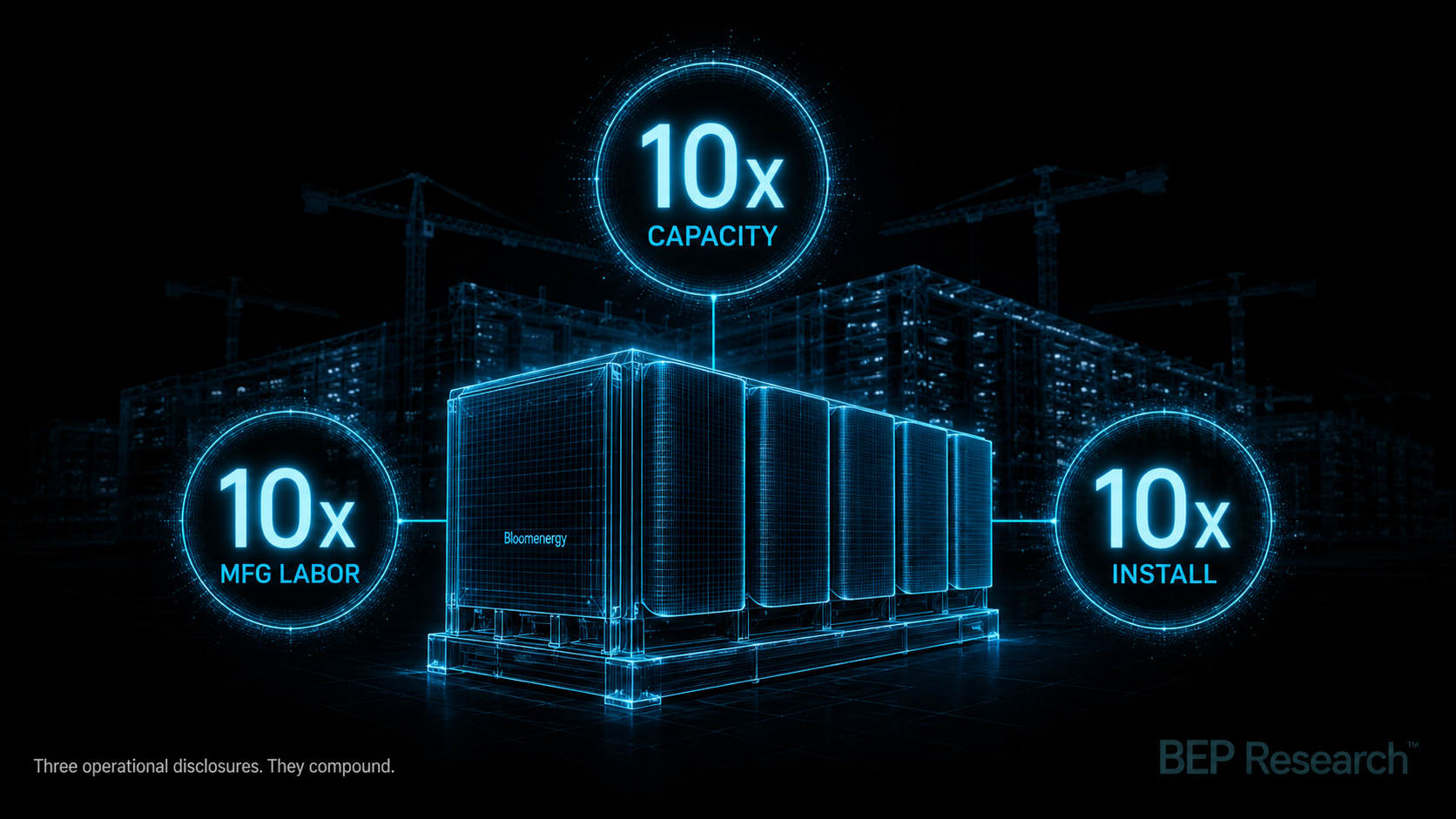
Tonight’s prepared remarks were strong. The Q&A is where the call earned its place in the four-piece arc. K.R. answered analyst questions with operational disclosures that should reset how the bull case is modeled. Three of those disclosures all happened to land at “roughly an order of magnitude.” They compound. Most analysts will pick up one or two and miss the third. The bull case lives at the intersection of all three.
The first one, on capacity, is the cleanest. Listen to it directly:
K.R. Sridhar, Bloom Energy Q1 2026 earnings call. The 5 GW capacity disclosure that ends the Jefferies bear thesis.
That paragraph is the answer to Jefferies’ February Underperform/$92 PT, which was built explicitly on the concern that Bloom had not announced capacity expansion. Tonight K.R. disclosed the existing factory footprint can deliver 5 GW annually, 2.5x the previously stated ceiling. Bloom does not need to break ground on a new factory to convert the backlog. The capacity is sitting there.
That is one of three. The second is a manufacturing labor leverage equation that produces 200bps of gross margin expansion on top of an 80% revenue raise. The third is a deployment innovation K.R. himself flagged on the call as “a huge innovation we have not talked about” — and it changes customer concentration risk math.
Below the paywall: the second and third 10x’s that make the operating leverage equation work, the inference TAM expansion that resets the long-term model, the bear cases K.R. killed in two sentences, the customer concentration math after tonight, and updated targets.
Leave a Reply